

Why Is Hands-On Learning Important in Montessori Education?
August 27, 2026
Children are naturally curious. They learn by touching, observing, moving, experimenting, and interacting with the world around them. This natural approach to learning is one of the key principles behind Montessori education.
Unlike learning methods that depend heavily on memorization or teacher-led instruction, Montessori education encourages children to actively participate in their learning. They work with carefully designed materials, complete purposeful activities, repeat tasks, solve problems, and gradually develop independence.
This approach is known as hands-on learning.
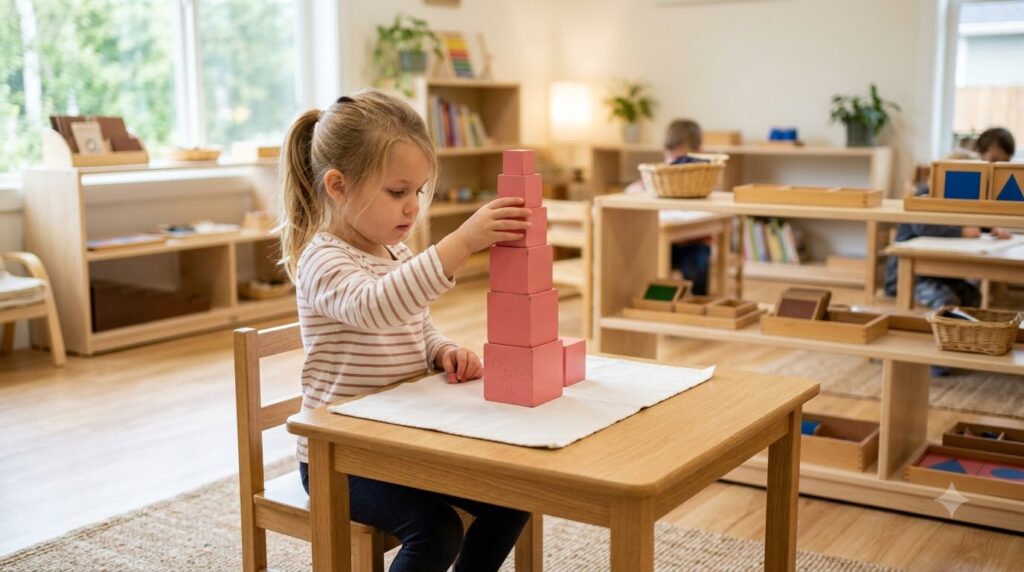
For young children, hands-on experiences can make learning more meaningful because they allow them to experience concepts rather than simply hear about them. From counting objects and tracing letters to pouring water and caring for plants, Montessori activities connect learning with real-world experiences.
For parents considering Montessori education, understanding the importance of hands-on learning can help explain how a Montessori environment supports a child’s overall development.
What Is Hands-On Learning in Montessori Education?
Hands-on learning means learning through direct interaction and purposeful activity.
Instead of simply listening to a teacher explain a concept, children are encouraged to explore and work with materials themselves.
For example, rather than only learning that a triangle has three sides, a child may hold a triangle, trace its edges, compare it with other shapes, and identify it among different objects.
Similarly, instead of simply memorizing numbers, a child may count physical objects and connect quantities with number symbols.
Montessori materials are specifically designed to help children move from concrete experiences toward abstract understanding.
The child can see, touch, move, compare, arrange, and manipulate materials while developing an understanding of the underlying concept.
Why Is Hands-On Learning Important for Young Children?
Young children are still developing their ability to understand abstract information. They often understand ideas more easily when they can experience them physically.
Hands-on learning provides opportunities to:
- Explore concepts directly
- Use multiple senses
- Practise new skills
- Repeat activities
- Make choices
- Solve simple problems
- Learn from mistakes
- Develop independence
- Build concentration
- Connect learning with everyday life
Instead of treating learning as something that happens only through books or verbal instruction, Montessori education creates an environment where learning can happen through purposeful action.
1. It Makes Abstract Concepts Easier to Understand
One of the biggest benefits of hands-on learning is that it makes abstract concepts more concrete.
For a young child, the number “5” is simply a symbol. However, when the child counts five physical objects, the symbol begins to represent something they can actually understand.
The same principle applies to many areas of early education.
Children can explore:
- Numbers through counting materials
- Shapes through physical objects
- Colours through matching activities
- Size through comparison
- Language through letters and sounds
- Patterns through sequencing
- Classification through sorting
This concrete experience can provide a strong foundation for more abstract learning later.
2. Children Become Active Participants in Their Education
Hands-on learning changes the role of the child.
Instead of simply receiving information, the child becomes an active participant.
A Montessori activity may involve observing a demonstration, selecting materials, attempting the task, making adjustments, repeating the activity, and eventually completing it independently.
This creates a learning process in which children actively engage with what they are learning.
They are not just asking, “What is the answer?”
They are also learning:
“How can I find the answer?”
That difference can encourage curiosity and independent thinking.
3. Hands-On Learning Encourages Curiosity
Children naturally want to investigate their surroundings.
A carefully prepared Montessori environment provides opportunities for that curiosity to develop.
A child working with materials may begin asking:
- Why does this piece fit here?
- Why is this object bigger?
- What happens when I pour the water?
- Which objects belong together?
- How can I complete this activity?
- What happens if I try again?
These questions encourage children to observe and investigate.
Rather than giving children every answer immediately, hands-on learning can give them opportunities to discover relationships and patterns for themselves.
4. It Helps Develop Concentration
Concentration is an important skill that develops over time.
Montessori classrooms provide purposeful activities that can encourage children to focus on a particular task.
A child may spend time:
- Completing a puzzle
- Sorting objects
- Building a sequence
- Tracing letters
- Counting materials
- Pouring water
- Arranging objects
- Completing a practical life activity
Children may also repeat an activity several times.
This repetition allows them to become more familiar with the task and gradually improve their ability to concentrate.
Rather than constantly moving from one activity to another, children can have the opportunity to become deeply engaged in meaningful work.
5. It Encourages Independence
Independence is one of the important goals of Montessori education.
Hands-on activities allow children to practise completing tasks on their own.
For example, children may learn to:
- Pour water
- Transfer objects
- Fold materials
- Organize items
- Button clothing
- Clean up after an activity
- Care for plants
- Return materials to their proper place
These activities may appear simple to adults, but they can require concentration, coordination, sequencing, and decision-making.
When children successfully complete age-appropriate activities, they can develop confidence in their ability to do things independently.
The message is simple:
“I can try it myself.”
6. Practical Life Activities Connect Learning With Everyday Life
One of the distinctive aspects of Montessori education is the importance given to Practical Life activities.
These activities are based on everyday tasks that children can learn to perform independently.
Examples may include:
- Pouring
- Scooping
- Folding
- Cleaning
- Sorting
- Organizing
- Dressing
- Caring for plants
- Simple food preparation
- Maintaining the classroom environment
These activities are not merely chores.
They can help children develop coordination, concentration, order, independence, and responsibility.
For example, pouring water requires the child to control movement, coordinate their hands and eyes, observe the amount of water, and respond appropriately if water spills.
One simple activity can therefore support several areas of development at once.
7. It Supports Fine Motor Development
Many Montessori activities require controlled hand movements.
Children may pick up small objects, transfer materials, thread objects, trace shapes, open containers, pour liquids, or arrange objects carefully.
These activities can provide opportunities to practise fine motor coordination.
Fine motor skills are important for everyday tasks and future academic activities such as:
- Writing
- Drawing
- Holding a pencil
- Using scissors
- Using utensils
- Dressing
- Handling classroom materials
Hands-on Montessori activities can make this practice meaningful because children are using their hands for a specific purpose rather than simply performing repetitive movements.
8. It Develops Hand-Eye Coordination
Hands-on activities frequently require children to coordinate what they see with how they move their hands.
For example, when pouring water, children need to watch the container while controlling its movement.
When completing a puzzle, they need to identify where a piece belongs and physically position it.
When arranging objects, they need to visually assess the materials and move them accurately.
Repeated experiences like these can support the development of hand-eye coordination.
9. Children Learn Through Repetition
Young children often need repeated practice to develop a new skill.
Montessori environments allow children to repeat activities when appropriate.
A child may complete the same activity several times because they are interested in it or because they are working toward greater control.
Through repetition, children can gradually:
- Improve accuracy
- Increase coordination
- Develop confidence
- Notice details
- Become more independent
- Strengthen concentration
Repetition is therefore not necessarily a sign that the child is doing the same thing without learning. It can be an important part of mastering a developing skill.
10. Hands-On Learning Develops Problem-Solving Skills
Purposeful activities naturally present children with challenges.
A puzzle piece may not fit.
Objects may be placed in the wrong order.
A structure may fall.
A sorting activity may not work as expected.
These situations provide opportunities for children to think and try different solutions.
Instead of immediately solving the problem for the child, the Montessori environment can encourage the child to observe what happened and attempt another approach.
This can support the development of:
- Logical thinking
- Observation
- Decision-making
- Persistence
- Reasoning
- Problem-solving
These skills can become useful across different areas of a child’s education.
11. It Teaches Children That Mistakes Are Part of Learning
Mistakes are a natural part of hands-on learning.
When children physically interact with materials, they can often see when something has not worked correctly.
They can then make another attempt.
This creates a valuable learning cycle:
Try → Observe → Correct → Repeat → Improve
Children can gradually learn that making a mistake does not mean they have failed.
Instead, a mistake can provide information about what they need to change.
This can encourage a more positive attitude toward challenges.
12. Montessori Materials Can Encourage Self-Correction
Many Montessori materials are designed to help children recognize errors independently.
For example, a piece may not fit, objects may not align correctly, or a sequence may not produce the expected result.
This gives the child an opportunity to notice the issue without always relying on an adult to provide the answer.
Self-correction can encourage children to develop:
- Observation skills
- Attention to detail
- Independent thinking
- Persistence
- Confidence
The goal is not simply for the child to get the correct answer. It is also to help them develop the ability to recognize and correct mistakes independently.
13. It Makes the Senses Part of Learning
Children use their senses to understand the world.
Montessori sensorial activities encourage children to explore qualities such as:
- Colour
- Shape
- Size
- Texture
- Weight
- Sound
- Dimension
Instead of simply being told that something is rough, smooth, heavy, light, large, or small, children can physically experience these differences.
This type of learning can encourage children to become more observant and attentive to details.
14. Hands-On Learning Can Make Education More Meaningful
There is a significant difference between memorizing information and understanding it.
Consider learning about shapes.
A child could memorize that a triangle has three sides.
Or the child could hold a triangle, trace it, compare it with a square, identify other triangles, and explore how different shapes are used in the environment.
The second experience provides more opportunities to connect the concept with direct experience.
Hands-on learning does not replace reading, conversation, or other forms of teaching. Instead, it can provide children with concrete experiences that support later abstract learning.
15. It Builds Confidence Through Achievement
Small achievements can have a significant impact on a young child’s confidence.
A child who successfully completes an activity may experience a sense of accomplishment.
It could be:
- Completing a puzzle
- Pouring without spilling
- Sorting objects correctly
- Learning to button clothing
- Finishing a counting activity
- Organizing materials independently
These experiences can help children understand that they are capable of learning new things.
As they encounter more challenging activities, previous experiences of success can encourage them to keep trying.
16. It Encourages Patience and Persistence
Children do not always master a new activity immediately.
A hands-on environment gives them opportunities to practise without expecting instant perfection.
When a child attempts an activity several times, they learn that improvement can happen gradually.
This can help develop:
- Patience
- Persistence
- Resilience
- Focus
- Confidence
These qualities are valuable not only during early childhood but throughout a child’s educational journey.
17. It Supports Social Development
Although Montessori education places considerable emphasis on independent activity, children also learn within a shared classroom environment.
They learn to respect:
- Other children’s work
- Classroom materials
- Shared spaces
- Individual boundaries
- Classroom routines
Children may also learn how to wait for materials, communicate with classmates, ask for assistance, and contribute to maintaining the environment.
This allows independence and social responsibility to develop together.
18. Hands-On Learning Encourages Meaningful Choice
Montessori classrooms often provide children with appropriate choices within a carefully prepared environment.
Children may have opportunities to select activities based on their interests and developmental readiness.
This does not mean that children can do anything they want without boundaries.
The classroom has expectations regarding how materials are handled, how activities are completed, and how children interact with others.
This combination of choice and structure can help children practise decision-making and responsibility.
19. It Connects Different Areas of Development
One hands-on activity can support multiple skills simultaneously.
Consider a simple pouring activity.
The child may develop:
- Fine motor skills
- Hand-eye coordination
- Concentration
- Movement control
- Independence
- Sequencing
- Practical life skills
Similarly, a sorting activity can support:
- Observation
- Classification
- Logical thinking
- Vocabulary
- Fine motor skills
- Concentration
This integrated nature of learning is particularly valuable during early childhood.
20. The Montessori Teacher Plays an Important Role
Hands-on learning does not mean that children are left completely on their own.
The Montessori educator plays an essential role in preparing the environment, introducing materials, observing children, and providing guidance.
The teacher may:
- Demonstrate an activity
- Introduce appropriate materials
- Observe a child’s interests
- Recognize when a child is ready for a new challenge
- Provide guidance when necessary
- Encourage independence
- Maintain an organized learning environment
The teacher therefore acts as a guide and facilitator while giving children opportunities to take an active role in their learning.
Hands-On Learning Across the Montessori Curriculum
Hands-on learning can be incorporated into different areas of Montessori education.
Practical Life
Children may practise pouring, transferring, folding, cleaning, organizing, dressing, and caring for their environment.
Sensorial Learning
Children explore differences in colour, shape, size, texture, weight, sound, and dimension.
Language
Children may work with letters, sounds, vocabulary, matching activities, tracing materials, and other language resources.
Mathematics
Children can use concrete materials to explore counting, quantity, number relationships, sequencing, and mathematical operations.
Cultural Learning
Age-appropriate activities can introduce children to nature, geography, culture, science, history, and the world around them.
Through these experiences, children can encounter concepts through active participation.
How Parents Can Encourage Hands-On Learning at Home
Hands-on learning does not have to stop when children leave the classroom.
Parents can provide simple opportunities at home.
Depending on the child’s age, parents can involve children in activities such as:
- Putting toys away
- Watering plants
- Sorting clothes
- Folding small towels
- Organizing books
- Setting the table
- Helping with simple food preparation
- Matching socks
- Cleaning up after activities
The objective is not perfection.
Children may take longer to complete a task or make mistakes. Give them reasonable opportunities to try, while ensuring that activities are safe and age-appropriate.
Parents can also encourage thinking by asking questions such as:
- “What do you notice?”
- “What could you try next?”
- “Where do you think this belongs?”
- “Would you like to try again?”
These simple interactions can encourage children to think about their own learning.
What Should Parents Look for in a Montessori School?
If you are considering Montessori education for your child, look beyond the school’s use of the word “Montessori.”
During a school visit, parents can observe:
- Whether children actively engage with materials
- Whether learning materials are organized and accessible
- Whether the classroom feels purposeful and orderly
- How teachers introduce activities
- Whether children have opportunities for independent work
- Whether activities are age-appropriate
- How teachers respond to children’s mistakes
- Whether children are encouraged to care for the environment
- Whether the school follows a consistent Montessori approach
It can also be helpful to ask about educator training, classroom age groups, daily routines, curriculum implementation, and how the school supports individual children’s development.
Why Hands-On Learning Matters in Early Childhood Education
Early childhood is a crucial period for developing foundational abilities.
Children are learning how to:
- Communicate
- Concentrate
- Move with coordination
- Solve problems
- Make decisions
- Interact with others
- Perform everyday tasks
- Understand their environment
Hands-on learning provides opportunities to practise many of these abilities through purposeful experiences.
Research on Montessori education has reported positive outcomes across several academic and non-academic areas, although results vary between studies and the quality and implementation of Montessori programs are important considerations.
This means parents should evaluate the actual quality of a Montessori environment, rather than assuming that every school using Montessori materials provides the same educational experience.
How Casa Bambino Supports Hands-On Learning
At Casa Bambino, hands-on learning can form an important part of creating a meaningful early childhood experience.
A thoughtfully prepared learning environment gives children opportunities to explore concepts, work with purposeful materials, practise everyday skills, and gradually become more independent.
Through appropriate activities and supportive guidance, children can develop:
- Curiosity
- Concentration
- Independence
- Confidence
- Coordination
- Problem-solving skills
- Practical life skills
- Responsibility
The goal is not simply to keep children engaged with activities.
The goal is to create meaningful learning experiences that support their development.
Every activity can provide an opportunity to observe, explore, practise, discover, and grow.
Final Thoughts
Hands-on learning is an important part of Montessori education because it allows children to learn through experience.
Instead of simply listening to an explanation, children can interact with materials, explore concepts, practise skills, make mistakes, and discover solutions.
From practical life activities and sensorial exploration to language and mathematics, hands-on learning can support a wide range of developmental skills.
It can encourage:
- Independence
- Concentration
- Curiosity
- Fine motor development
- Problem-solving
- Persistence
- Confidence
- Social responsibility
Most importantly, hands-on learning recognizes that children are active learners.
They learn by doing, observing, repeating, questioning, and discovering.
For parents searching for an early childhood education environment, understanding this approach can help them make a more informed decision about what kind of learning experience may suit their child.
At Casa Bambino, purposeful hands-on experiences can help children develop a strong foundation for future learning while encouraging them to become curious, confident, capable, and independent learners.
Frequently Asked Questions
What is hands-on learning in Montessori education?
Hands-on learning involves children actively interacting with materials and completing purposeful activities to understand concepts. Montessori classrooms use hands-on activities across Practical Life, Sensorial, Language, Mathematics, and other areas of learning.
Why is hands-on learning important for children?
Hands-on learning can help children understand concepts through direct experience while supporting concentration, coordination, independence, curiosity, problem-solving, and confidence.
What are some examples of hands-on Montessori activities?
Examples include pouring, sorting, transferring objects, matching, counting, tracing letters, completing puzzles, folding, organizing, cleaning, and other age-appropriate practical activities.
Does hands-on learning help children become independent?
Yes. Purposeful activities can give children opportunities to practise everyday skills independently and develop confidence in their ability to complete tasks.
Does Montessori education involve teaching?
Yes. Montessori educators actively prepare the classroom environment, demonstrate activities, observe children, provide guidance, and introduce appropriate challenges. Children are also given opportunities to participate actively and independently.
Can parents use hands-on learning at home?
Absolutely. Parents can involve children in age-appropriate everyday activities such as organizing toys, watering plants, sorting objects, folding clothes, setting the table, and helping with simple household tasks.
Is hands-on learning only useful for preschool children?
Hands-on learning can be valuable at different stages of education. However, it is particularly relevant during early childhood because young children naturally learn through movement, sensory experiences, exploration, and direct interaction with their environment.