

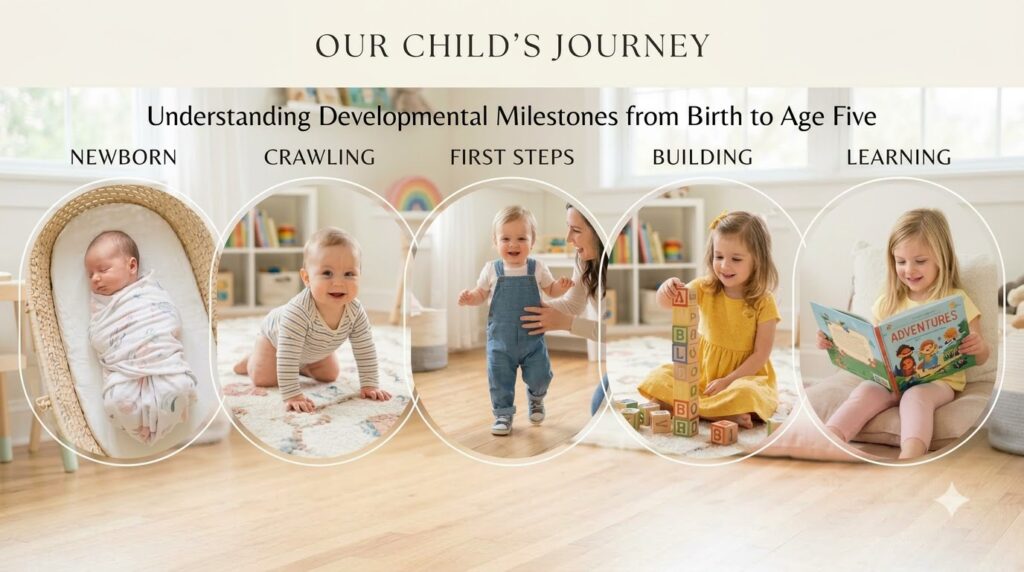
Understanding Developmental Milestones from Birth to Age Five
September 22, 2026
The first five years of a child’s life are filled with remarkable growth and discovery. From a baby’s first smile to a five-year-old confidently expressing ideas, every stage brings new abilities, experiences, and opportunities for learning.
Understanding developmental milestones helps parents and educators appreciate what children are learning at different stages, while remembering that every child develops at their own pace.
Developmental milestones are not a checklist that children must complete by a particular date. Rather, they are general indicators that help us understand a child’s growth across different areas.
What Are Developmental Milestones?
Developmental milestones are skills that most children develop within a certain age range. They generally fall into several areas:
- Physical development – movement, coordination, balance and fine-motor skills
- Language and communication – understanding and expressing thoughts, sounds and words
- Cognitive development – thinking, exploring, remembering, problem-solving and learning
- Social and emotional development – relationships, emotions, confidence and self-regulation
- Self-help skills – gradually becoming more independent with everyday routines
These areas are closely connected. A child’s physical, emotional, social and cognitive development all influence one another.
Birth to 12 Months: Discovering the World
During the first year, babies learn primarily through their senses, movement and relationships with the adults around them.
Physical Development
Babies gradually gain control over their bodies. They may begin by lifting their head, rolling over and sitting with support, and later progress towards sitting independently, crawling, pulling themselves up and possibly taking their first steps.
Communication
Communication begins long before a baby’s first word. Babies communicate through crying, facial expressions, gestures and sounds. They begin responding to familiar voices and may babble, imitate sounds and eventually say simple words.
Social and Emotional Development
Babies develop strong attachments to their caregivers. They may smile socially, enjoy interaction, respond to familiar people and show different emotions.
Cognitive Development
Babies are naturally curious. They explore by looking, touching, grasping, listening and putting safe objects into their mouths. They gradually begin to understand that objects and people continue to exist even when they cannot see them.
How adults can support them: Talk, sing, read, cuddle, respond to their sounds and provide safe opportunities for movement and exploration.
1 to 2 Years: Becoming More Independent
The second year often brings significant changes in movement, communication and independence. Toddlers become increasingly interested in exploring their surroundings and trying things for themselves.
Physical Development
Children may become more confident walkers and gradually learn to run, climb, squat and navigate simple obstacles. Fine-motor skills also improve, allowing them to pick up small objects, turn pages, stack blocks and begin using spoons or cups.
Communication
Vocabulary begins to grow. Children may use individual words and then start combining two or more words to communicate basic needs and ideas. They also understand more language than they can express.
Simple instructions such as “bring the ball” or “sit down” may become easier for them to follow.
Social and Emotional Development
Toddlers begin developing a stronger sense of independence. They may frequently say “no,” become frustrated when they cannot do something and show strong emotions.
They are also beginning to understand familiar routines and relationships, although sharing and waiting for their turn can still be difficult.
Cognitive Development
Children learn through active exploration. They may experiment with objects, imitate adults, recognize familiar pictures and begin solving simple problems, such as figuring out how to reach a toy.
How adults can support them: Offer safe choices, name objects and actions, read picture books together, encourage movement and allow children to participate in simple everyday tasks.
2 to 3 Years: Exploring Language and Imagination
Between two and three years, children’s language, imagination and social awareness often develop rapidly. They increasingly want to communicate their thoughts and take part in everyday activities.
Physical Development
Children may run more confidently, climb, kick or throw a ball and begin jumping with both feet. Their fine-motor abilities continue to develop, allowing them to draw simple marks, turn pages and manipulate toys with greater control.
Communication
Children may learn many new words and begin speaking in short sentences. They can increasingly name familiar objects, people and actions and may ask frequent questions.
Their ability to understand simple conversations also improves.
Social and Emotional Development
Children begin recognizing themselves as individuals with their own preferences and opinions. They may show affection, imitate adults and engage in simple forms of pretend play.
Strong emotional reactions are still common because self-regulation is developing gradually.
Cognitive Development
Pretend play becomes increasingly interesting. A child might use a toy phone to imitate a parent or pretend that a box is a car.
Children also begin recognizing basic patterns, sorting objects and remembering familiar routines.
How adults can support them: Encourage pretend play, ask simple questions, read regularly, introduce songs and rhymes, and help children name their emotions.
3 to 4 Years: Building Confidence and Social Skills
By the preschool years, children are becoming more capable communicators and increasingly interested in interacting with other children.
Physical Development
Children generally become more coordinated. They may run, jump, climb, pedal a tricycle or similar ride-on toy and throw or catch a ball with increasing control.
Fine-motor skills also improve. Children may begin drawing recognizable shapes, using crayons with greater control and attempting to use scissors under supervision.
Communication
Children may speak in longer sentences and participate in simple conversations. They increasingly ask “why” and “how” questions as they try to understand the world around them.
Their vocabulary expands quickly through conversations, books, songs and everyday experiences.
Social and Emotional Development
Children begin developing friendships and learning how to participate in group activities. They may show greater interest in taking turns, cooperating and following simple rules.
However, conflicts over toys, attention or ideas are still normal and provide opportunities to learn social skills.
Cognitive Development
Children become increasingly interested in counting, colors, shapes, stories and simple concepts. Their imagination becomes more elaborate, and pretend play may involve characters, roles and simple storylines.
How adults can support them: Provide opportunities for creative play, storytelling, drawing, music and group activities. Encourage children to solve simple problems rather than immediately providing the answer.
4 to 5 Years: Preparing for Greater Independence
Between four and five years, children often become more confident in communicating, moving, learning and interacting with others. They are beginning to develop many of the skills that will support their transition into formal schooling.
Physical Development
Children may demonstrate better balance, coordination and body control. They can often run, jump, climb and participate in simple physical games.
Fine-motor abilities continue to improve, supporting activities such as drawing, coloring, building, using child-safe scissors and beginning to write some letters or numbers.
Communication
Children can generally participate in longer conversations and describe experiences, stories and ideas. They may ask detailed questions and enjoy listening to stories.
They also become increasingly capable of following multi-step instructions, although their ability to do so can vary depending on the situation.
Social and Emotional Development
Children become more aware of other people’s feelings and perspectives. They may cooperate in group activities, develop friendships and begin understanding concepts such as fairness and rules.
They are also learning to manage frustration, wait for their turn and express emotions with words rather than actions.
Cognitive Development
Children become increasingly interested in numbers, letters, shapes, patterns and the world around them. They may count objects, recognize some letters and numbers, remember parts of familiar stories and engage in increasingly complex pretend play.
Their ability to focus on an activity also gradually increases.
How adults can support them: Read together every day, encourage questions, provide puzzles and building activities, practice counting through everyday experiences and allow children to complete age-appropriate tasks independently.
5 Years: Developing School-Ready Skills
By around five years, many children have developed a broader range of physical, language, cognitive and social abilities. They are becoming more independent and increasingly capable of participating in structured learning environments.
Physical Development
Children may have improved balance, coordination and control over both large and small movements. They can participate in running, jumping and other active games and may show increasing control when drawing, writing, cutting and building.
Communication
Children can often tell simple stories, describe events and participate in conversations. They may understand increasingly complex instructions and use language to explain their ideas, ask questions and solve problems with others.
Social and Emotional Development
Children increasingly understand social expectations and can participate in cooperative activities. They may develop stronger friendships and become better at managing emotions, although they still need adult support when situations become difficult.
Cognitive Development
Children are developing early academic concepts alongside broader thinking skills. They may recognize letters and numbers, count objects, identify shapes and patterns and demonstrate growing interest in reading, writing and mathematics.
They also continue developing reasoning, memory and problem-solving abilities through play and everyday experiences.
How adults can support them: Encourage independent routines, read a variety of books, provide opportunities for writing and drawing, play counting and sorting games, and give children opportunities to explain their thinking.
Developmental Milestones Across the First Five Years
Although development happens continuously, it can be useful to look at the broader progression:
| Age | Physical | Communication | Cognitive | Social & Emotional |
| Birth–1 year | Rolling, sitting, crawling, standing | Sounds, babbling, gestures, early words | Exploring, recognizing people and objects | Attachment, smiles, emotional responses |
| 1–2 years | Walking, climbing, improved hand control | Words and simple combinations | Exploring, imitation, simple problem-solving | Independence, strong emotions |
| 2–3 years | Running, jumping, improved coordination | Short sentences, growing vocabulary | Pretend play, sorting, remembering routines | Self-awareness, emerging social play |
| 3–4 years | Better balance and coordination | Longer conversations, questions | Early concepts, imagination, problem-solving | Cooperation, friendships, turn-taking |
| 4–5 years | Increasing physical and fine-motor control | Storytelling and detailed conversations | Early literacy, numeracy, patterns | Perspective-taking, emotional regulation |
| Around 5 years | Greater coordination and independence | More complex communication | School-readiness skills and reasoning | Cooperation, friendships and self-regulation |
Why Play Is Important for Development
Play is one of the most important ways young children learn. It gives them opportunities to experiment, communicate, solve problems, use their imagination and practice social interactions.
Different types of play support different developmental areas:
- Physical play supports strength, balance and coordination.
- Pretend play encourages imagination, language and social understanding.
- Building and construction play supports problem-solving and fine-motor skills.
- Puzzles and matching games encourage memory, reasoning and concentration.
- Art and creative activities support expression and coordination.
- Group games help children learn cooperation, turn-taking and following rules.
Children do not always need expensive educational toys. Everyday objects, books, household activities and opportunities to interact with adults can provide valuable learning experiences.
The Role of Parents and Caregivers
Adults play a central role in supporting early development. Simple everyday interactions can have a significant impact.
Talk With Children
Describe what you are doing, ask questions and respond to children’s attempts to communicate. Conversations help build vocabulary and understanding.
Read Together
Reading aloud supports language development, listening, imagination and early literacy. Repeating favorite stories can also help children become familiar with words and story structures.
Encourage Movement
Give children safe opportunities to crawl, walk, run, climb, jump and play. Physical activity supports both motor development and overall learning.
Encourage Independence
Allow children to try age-appropriate tasks themselves, such as putting away toys, choosing between two options or helping with simple household activities.
Respond to Emotions
Young children are still learning how to regulate their emotions. Naming feelings and calmly helping children work through frustration can support the development of emotional regulation.
Provide Opportunities to Explore
Children learn by asking questions, experimenting and making mistakes. Safe exploration allows them to develop curiosity and problem-solving skills.
When Should Parents Be Concerned About Development?
Developmental variation is normal. Children may reach different milestones at somewhat different times, and progress is not always linear.
However, parents and caregivers should discuss concerns with a pediatrician or other qualified healthcare professional if a child:
- loses a skill they previously had
- is not progressing in one or more developmental areas
- consistently has difficulty communicating or interacting
- has significant difficulty with movement or coordination
- or causes persistent concern for their caregivers
A developmental concern does not automatically mean that a child has a developmental disorder. Professional evaluation can help determine whether additional support is appropriate.
Supporting Every Child’s Individual Development
Milestones are useful because they provide a general picture of development, but they should not be used to compare children unnecessarily.
Two children of the same age may have different strengths. One may develop language skills quickly, while another may demonstrate advanced physical coordination or strong social curiosity.
What matters is understanding the child’s overall developmental pattern, providing appropriate opportunities to learn and seeking professional guidance when there are concerns.
Final Thoughts
The first five years provide a remarkable foundation for future learning and development. Children gradually move from communicating through cries and gestures to expressing complex ideas, from discovering movement to developing coordination, and from relying heavily on caregivers to becoming increasingly independent.
Parents, caregivers and educators can support this journey through responsive relationships, conversation, reading, play, movement, exploration and encouragement.
Most importantly, developmental milestones should be viewed as guides rather than deadlines. Every child follows a unique developmental path, and creating a safe, responsive and stimulating environment gives children the opportunity to learn and grow at their own pace.